My first visit to a Citirama show last weekend. I think they have these every year? This is a takeoff on those Homeramas they have out in the suburbs, where you can ooh-and-ahh at pretty awful yet pretty big spec housing, and the fabulous interior decorating inside. At least that was what the Homeramas were like in in Louisville. I haven't been to one in Dayton yet but I figure they are similar.
Anyway, this Citirama was in the old University of Dayton (UD) "student ghetto", an old blue collar neighborhood off of Brown Street, between the UD campus and Irving Street. What's happened here is that UD had acquired probably nearly all of the housing in the neighborhood, and is using it student housing. What usually happens in these cases is the houses are acquired before they are torn down for campus expansion, but are rented out to students in the interim, which form funky little communities of young folks. A famous example of this was Perry Lane next to Stanford, immortalized in Tom Wolfe's "The Electric Kool-Aid Acid Test" as the home of Ken Kesey and his circle.
Here in Dayton something different happened. UD kept the houses, and, instead of tearing down the neighborhood for expansion or conventional dorms, is housing students this way as a matter of policy. This is pretty unusual for a US university. Since the neighborhood is now a keeper, UD is renovating the houses, and building new infill in some cases. Citirama had a block of new row houses on display, which was designed to break up the mass of the building so it would read as individual units. There was some remodeled older units on show, too. The interiors are pretty spartan, designed for hard use, which is to be expected with dormitory rooms. I noticed that the upperclassmen can live in a slightly larger unit, and there was definitely ADA compliance in the latrine layout.
But the real story here is that UD is committing to a form ofneighborhood conservation; instead of bulldozing everything for a big new impersonal "complex", they keep the old neighborhood, with all its positive features such as walkability, front porches, and human scale.
And there is the fabulous Art Street
...which is probably one of my favorite new buildings in Dayton right now (this is worth it's own post).
Take a quick online tour of Citirama (and more commentary from yer humble host) at the Urban Ohio Citirama pix thread
Wednesday, August 8, 2007
Citirama!


Monday, August 6, 2007
Witamy....to Dayton's Polonia!
 The occasion was the annual Polish Club Picnic at the "Polish Country Club" picnic grove off Needmore Road. One of secrets of the Dayton area as it is so under-promoted. I've heard about this event in the past (usually on the German radio program!), but this was my first visit.
 Icky weather, but a nice little crowd, a polka band: Duane Malinowski (are they local? They play the Czechoslovakian Club a lot), and, of course, food and beer. Probably one of the few opportunities outside of the Amber Rose to get kolachki, pierogi, and golabki (pronounced ga-wump-k), and that sour-cream & onion cucumber salad. And sausages. They said this food was from "Sigs" though Sig the butcher has been closed for years now, so maybe it’s the kids using the old recipes ?
 Polonia? What is that, you may ask? It is the Polish Diaspora, people of Polish ancestry who live outside of Poland. I come from the Chicago Polonia, from an old working class neighborhood that grew up around the factories and the church, settled mostly by Poles and a few Italians. American urban Polonia is pretty much like that, found mostly along or near the Great Lakes and in the Northeast, too (like the industrial towns of the Connecticut Valley).
Dayton is about as far south as one finds this urban Polish history. The Poles settled at the edge of Old North Dayton out Valley Street, founding St Adalberts parish (1903), and the Polish Club across the street.  One would think this community is gone, moved to suburbia, but the census still shows a light concentration of Poles in that census tract, which is about right as the Poles were among the last of the Eastern/Southern European immigrant groups to finally assimilate, and leave their city neighborhoods. Old North Dayton was the old neighborhood for a number of eastern Europeans groups: the Poles, the Lithuanians, the Hungarians, and the Germans, who founded the first parish in the neighborhood in 1880s and have a similar picnic grove (the Eintracht). The last relics here are the parishes themselves, the social clubs, Charlie's import market, and the excellent Amber Rose restaurant, a true Dayton treasure.
Though I grew up in a similar community in Chicago I have no connection to the one in Dayton, and have been to only one event here before, a parish carnival at St Adalberts. And to a Cityfolk event at the Polish Club for Irish or Scots music/dance. So coming to this picnic was exploring new ground for me. This is a good place to go with a group, and especially with your girlfriend or wife, as the centerpiece is the music and dancing. 
Sunday, August 5, 2007
Greenways for West Dayton


Lots more here illustrating the concept:
West Dayton Regional Open Space
The idea is to address the mix of large scale industrial abandonment and underutilization + ongoing residential abandonment on the West Side + demolition of public housing.
An urban design concept is investigated involving a mix of large urban parks (something Dayton lacks), forest preserves, and urban ag, tied together by a bikeway and parkway system.
The concept also works with the topography by proposing a skyline drive, and suggests urban infill and commercial intensification in the remaining neighborhoods, as well as parkside housing to better define the city edge at the parks.
Note that this is mere "paper architecture" as there are no real-life proposals for something like this.
Friday, August 3, 2007
The Rev Cool
The Rev Cool.
Not that he needs an plugs or promotion as he does that pretty good by himself. Just a tribute to a local character that makes Dayton "Daytonesque", and the first of occasional posts on the local live music scene.
This guy (and he apparently is a reverend of some sort, as well as a school teacher) has run that Round the Fringe radio show on WYSO 91.3 since the early 1980s, and he plays a mix of dance music, "world beat", and alt rock, usually with an emphasis on local bands. And, for me, that earns him his "Cool" title considering it's pretty rare for local talent to get airplay.
I started listening to him early on in my time in Dayton, and even bought one of his compilation LPs (yes, vinyl) Hard to be Cool in an Uncool World.
He used to be just a disembodied DJ voice on the radio until I started seeing him MC at the Cityfolk Festival jazz tent. Now he has a Myspace page in that Myspace Music section (which is the extent of my exposure to "socail networking").
In the 19 years of living in Dayton he has provided the soundtrack to many a Friday nights for me, and he's spinning those discs right now.
Thursday, August 2, 2007
Section 8 Hits the News
Interesting article and commmentary in the Dayton Daily News about "Section 8", the program to disperse poor people eligible for housing assistance out to the suburbs.
Reading the article and the comments one notices there really isn't much of this housing in the south suburbs, yet there is a perception that there is.
What is happening is, I think, that there is a surplus of older apartment & multifamily housing in the suburbs, thus rents are low. So people are moving up out of Dayton to these complexes, so as to be closer to work, have better schools for their kids, and escape crime and substandard housing.
These people are probably not on section 8, but are mostly likley poorer than the homeowners in the surrounding subivisions or poorer than earlier residentents of the complex. And there is a good chance they are black or even Mexican, as well as poor white. If they are renting and working in Washington or Miami Township they might be avoiding city income tax, too.
So there is this perception that there is more section 8 than there really is, and what people are noticing is the working poor leaving the city for better conditions in the suburbs, which are affordable to them as rentals but not via home ownership.
Wednesday, August 1, 2007
A Better Approach to Suburban Highways


One sees a sort of "Suburbia 2.0" in the new developments and highway work south of Dayton. Roads are now concieved as running through greenways of berms and landscaping, separating the highway from the surrounding residential development, which is sited away from the road a bit, with limited access. I am really glad to see this kind of thinking in suburban development as it certainly improves the aesthetics, turning highways into access-controlled parkways, as long as this is consistently carried through.
Commercial strips, though, still leave a lot to be desired. So far the best remains Route 725, mainly due to the extensive use of street trees and sign control.
Dayton: limits to "caring"/limits to "voice".
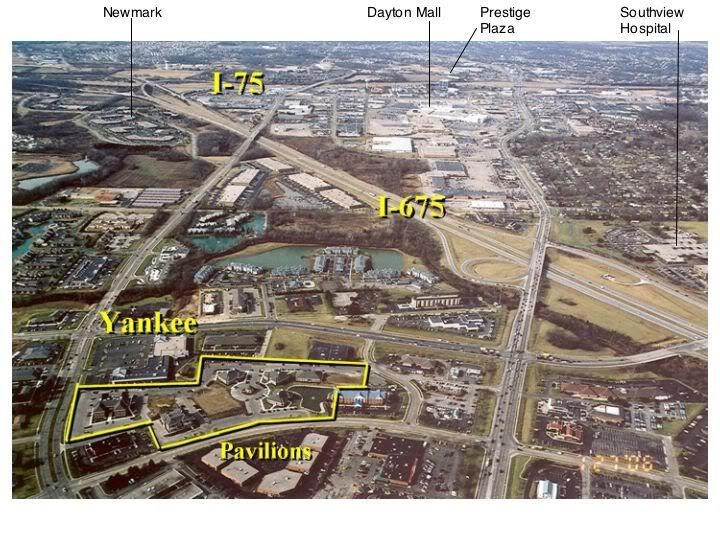
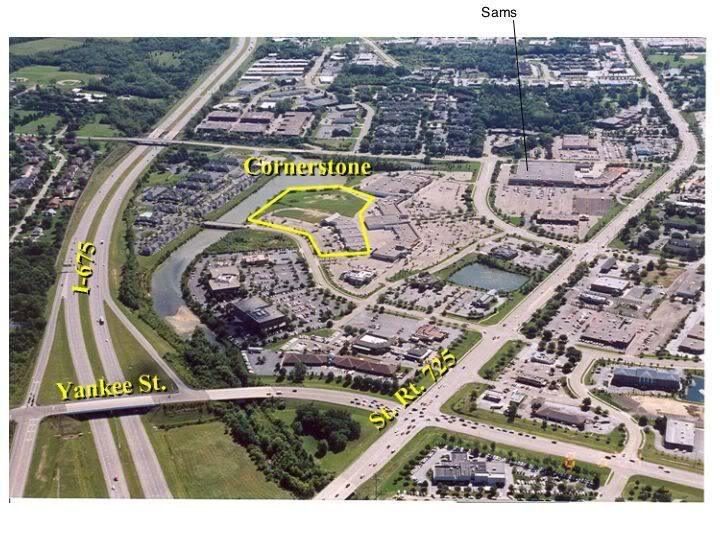
Dayton is really just the city of Dayton. Most people who live in this area do not identify with the city, but rather with the suburb they live in. For me it is Washington Township/Centerville, specifically the area in the pix above. which is really a suburban edge city, near the Dayton Mall. This and similar places near the freeways are where the real economic life of the Dayton metropolitan area is happening, and where most of the people live, work, and shop.
I enjoy studying the old city as sort of a hobby (and go down there for arts/music things), and I do post on Dayton city issues elsewhere . Yet I really am not a stakeholder in the city as I do not pay taxes there, don't own property there, nor vote there. It is merley a leisure-time entertainment place for me.
I can care about the place, or be interested in it , but only up to a point as I have no real voice or valid stake regarding city issues, which is something one needs to be aware of it.
As a topic of study and comment, I am also thinking suburbia is maybe more relevant, too, given its importance. Living here in Washington Township is an excellent urban observatory for suburban studies. There is even a journal devoted to the suburban studies concept: Oopollis